

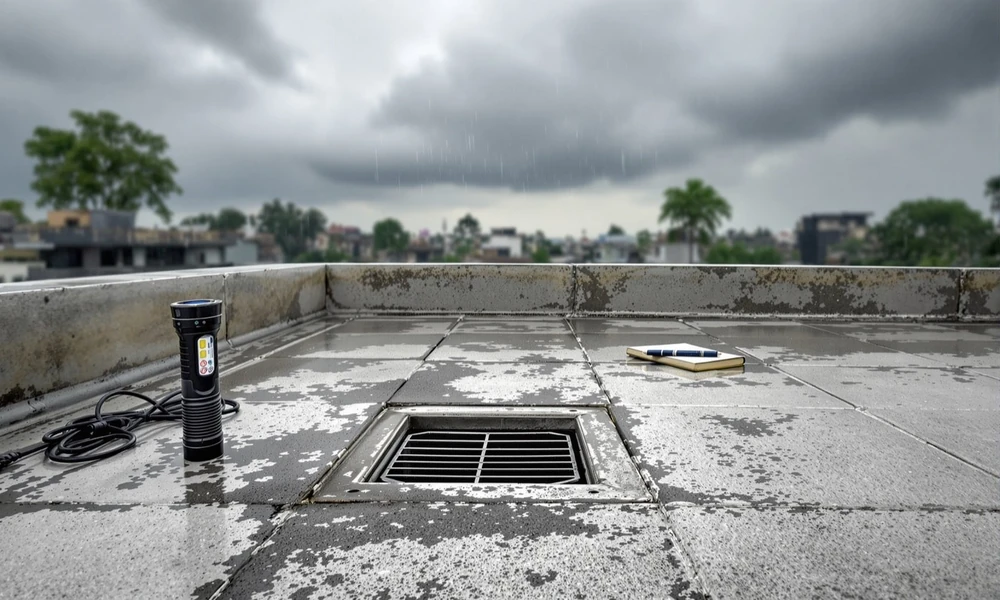
A steep residential roof deflects part of a hailstone’s energy, so the stone glances off and rolls away. A low slope commercial roof doesn’t have that advantage. Stones land almost straight down, and the full force of each impact goes into the membrane and whatever sits under it. That’s why two buildings on the same block can come out of the same storm very differently, one needing only a walkthrough and the other needing new insulation across half the roof.
Hail isn’t the only stress on the Front Range. At over 6,000 feet, UV exposure is noticeably stronger than at sea level. It slowly leaches plasticizers and stabilizers out of single ply membranes, and a white, powdery chalking on the surface is an early sign of it. Temperatures can also drop sharply within one afternoon, so seams expand and contract more often than a spec sheet assumes. Add winter snow drifting against parapets and rooftop units, and a flat roof in this region is under strain in almost every season.
Owners who want these factors weighed against their own building can start with a Colorado Springs commercial roof assessment from Desbro Roofing. The locally based team replaces and maintains commercial roofs, repairs storm damage, and handles the insurance paperwork that follows a hail event. Its work on gutters and skylights means the edges and openings of a roof get checked along with the membrane. For a property manager, that means one contractor with one set of photos and a clear recommendation on whether the roof can be repaired, recovered, or needs to come off.
Reading the roof from the top down
A commercial roof is an assembly of layers, and hail performance depends on how those layers work together.
The membrane. Thickness is the first variable. Many Front Range roofers now treat 60 mil as the minimum in hail areas and favor 80 or 90 mil where the budget allows. TPO is the most common choice on newer buildings because it’s reflective, heat welded at the seams, and moderately priced. EPDM usually costs less and repairs well with tapes and primers even when it’s old. PVC stands up best to grease and chemicals, which is why it’s standard over restaurant exhaust fans. However, it tends to become brittle with age faster than the other two, and older PVC roofs are more likely to crack in a storm.
The cover board. This layer is often left out to save money. A rigid board of high density polyiso, gypsum, or composite placed under the membrane spreads out each impact before it reaches the insulation. Manufacturers building assemblies for FM Global’s very severe hail zone, which covers much of the Front Range, usually pair a fully adhered membrane with a cover board for this reason.
The insulation. Polyiso can take real damage without anything showing on the surface. A mechanically attached membrane over soft insulation lets stones crush the foam and crack its facer, leaving hollow spots that collect water. A moisture survey using infrared, capacitance, or core cuts is the only reliable way to find that hidden damage.
The deck. Steel decks under snow load show every weakness in the drainage design. Water ponding for more than about two days after rain usually means the tapered insulation or drain placement needs to be corrected. Ponding also freezes into ice sheets that make the next hail impact worse.
Why age matters as much as material
The same product behaves very differently depending on how long it has been exposed. Field inspections after Front Range storms tend to show a consistent pattern:
- Under about five years, 60 mil or thicker. Hail usually leaves surface bruising and no leaks, and the roof often needs no claim at all.
- Ten to fifteen years. Bruises that looked harmless in June can develop stress cracks by winter, since the weakened spots flex through daily temperature swings. Seams near curbs and pipe penetrations are the first to separate.
- Fifteen years and older, especially at 45 mil. The same storm that bruises a newer roof can puncture this one. Seams fail in several places, and budgeting for replacement usually makes more sense than repeated patching.
Age also determines whether a recovery is possible. Building codes generally limit a roof to two layers. Any wet insulation has to be removed before a new membrane goes over the top. Silicone restoration coatings can add years to a roof that is dry and structurally sound, but they won’t fix a saturated one.
Energy rules now affect roofing decisions
A full tear-off where insulation sits entirely above the deck usually triggers current energy code insulation levels, and that changes the project budget. For larger properties there’s a second consideration. Colorado’s building performance program covers most commercial and multifamily buildings of 50,000 square feet or more and sets energy targets for 2030. A reroof is one of the few times insulation can be added at a reasonable cost, so owners of covered buildings often treat roof replacement and energy compliance as a single project. Reflective white membranes help with summer cooling loads. Because the region is heating dominated, though, added insulation usually does more for annual energy use than surface color does.
Edges, openings and rooftop traffic
Much of a flat roof’s risk is at its edges and openings rather than in the open field of membrane.
Perimeter edge metal on commercial buildings has to meet tested securement standards referenced in the building code. That matters here because wind following a hailstorm often starts peeling a roof at a loose corner. Gutters and downspouts on low slope buildings take a lot of water during summer storms. Undersized or dented gutters overflow down the walls and into foundations.
Skylights need attention for both durability and safety. Older acrylic domes crack in hail. Federal workplace rules treat skylights as fall hazards, so they need screens or guardrails whenever anyone works on the roof.
Foot traffic causes a surprising amount of membrane damage. HVAC technicians who drop tools or drag equipment create punctures that look like storm damage. Walkway pads along service routes prevent most of these problems.
A fall roof walk before the snow
October is a good time for a documented inspection. Records of spring and fall inspections support warranty claims and make any storm claim easier to defend. A thorough walk includes:
- Clearing drains, scuppers and gutters of summer debris
- Checking seams around rooftop units, curbs and pipe boots
- Probing soft spots that might point to wet insulation
- Photographing edge metal, skylights and walkway pads
- Noting any ponding lines left from late summer rain
A flat roof on the Front Range lasts longest when its thickness, layers and drainage are designed for the local climate.